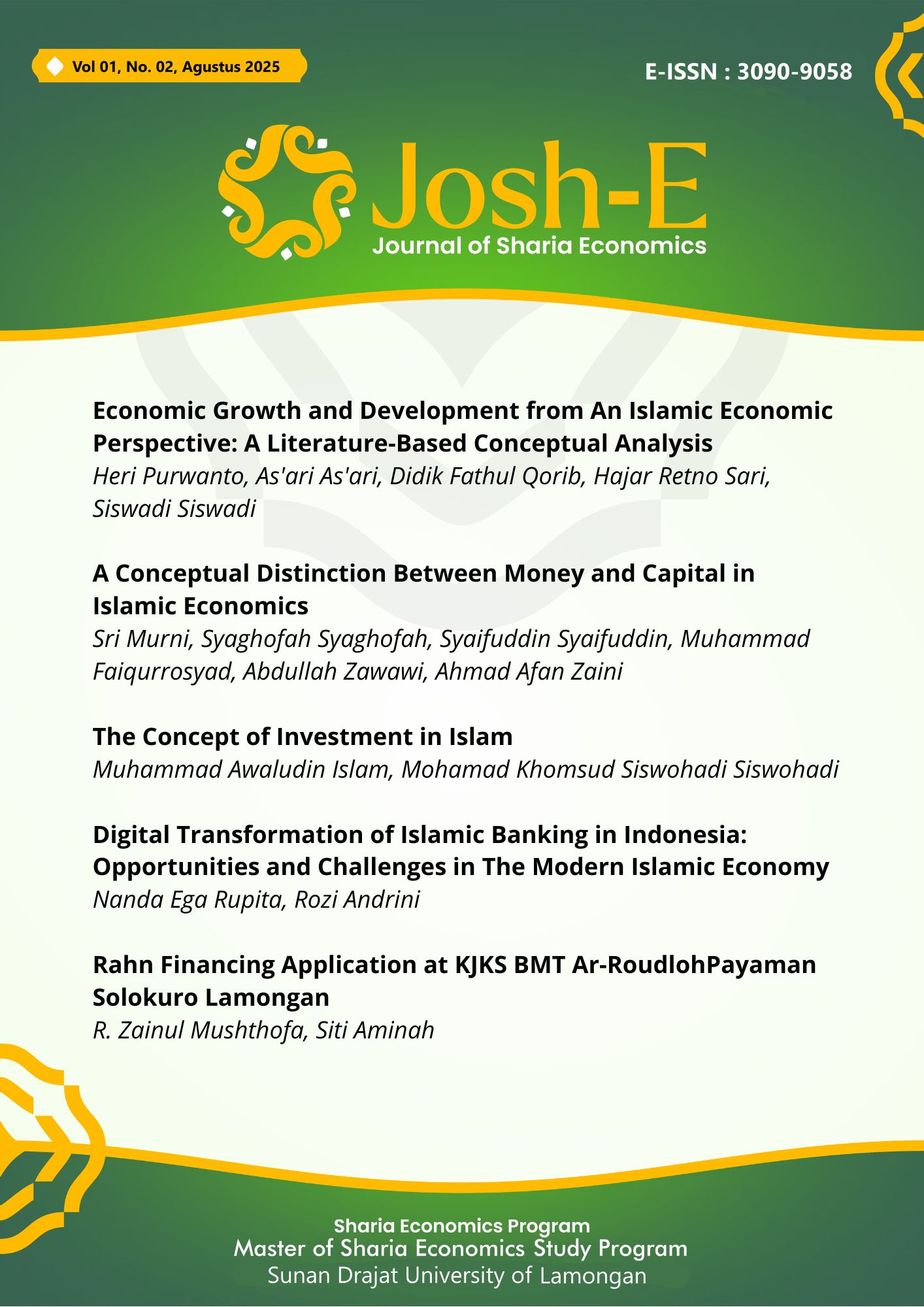
Digital Transformation of Islamic Banking in Indonesia: Opportunities and Challenges in The Modern Islamic Economy
DOI:
https://doi.org/10.55352/sxer6480Keywords:
Islamic Banking, Digital Transformation, Islamic EconomyAbstract
Digital transformation has become a key driver in the evolution of the global financial industry, including Indonesia’s Islamic banking sector. This research aims to explore the major opportunities and challenges of digital transformation within Indonesia’s Islamic banking system and proposes strategic recommendations grounded in the principles of maqasid al-shariah. Using a qualitative-descriptive approach through library research and content analysis of academic literature, policy documents, and Islamic financial data, the study finds that digitalization enhances service efficiency, broadens customer access, optimizes digital zakat and waqf management, and accelerates microfinance distribution. Nevertheless, several challenges persist, including limited technological infrastructure, low levels of digital and Islamic financial literacy, a shortage of skilled professionals combining tech and fiqh knowledge, and the absence of comprehensive digital shariah regulations. Moreover, the risk of shariah non-compliance—particularly in blockchain and smart contract applications—requires serious attention. To address these issues, the study recommends integrating Islamic values in technological design, strengthening the digital-shariah regulatory ecosystem, and improving stakeholder collaboration and literacy. Thus, digital transformation in Islamic banking is not merely a technical innovation but a value-driven process to build an inclusive, just, and sustainable Islamic financial system.
Downloads
Published
Issue
Section
License
Copyright (c) 2025 Nanda Ega Rupita, Rozi Andrini

This work is licensed under a Creative Commons Attribution-ShareAlike 4.0 International License.