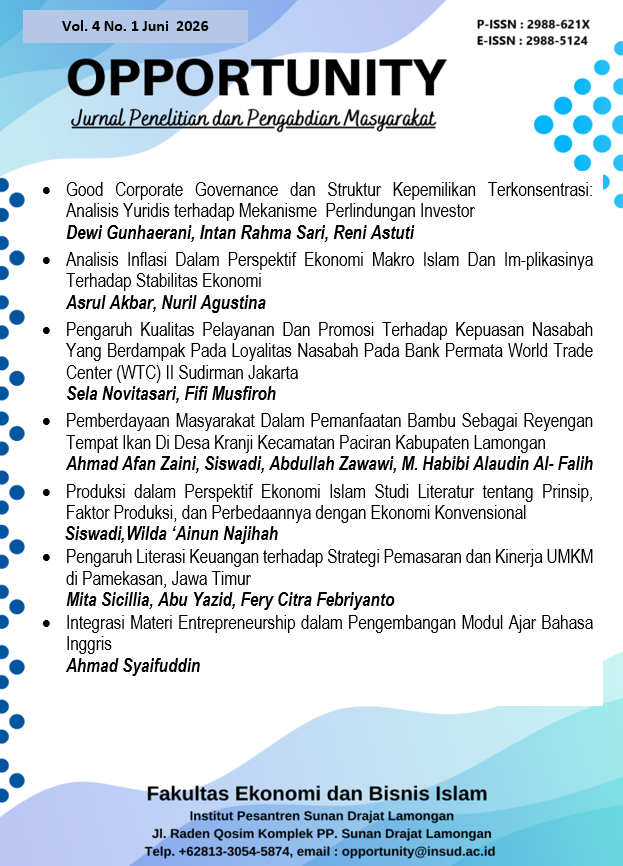
Integrasi Materi Entrepreneurship dalam Pengembangan Modul Ajar Bahasa Inggris
DOI:
https://doi.org/10.55352/ojppm.v2i1.788Keywords:
Deep Learning, English teaching module, teacher supportAbstract
Implementing a Deep Learning approach in education requires teachers to design instructional modules that foster meaningful, mindful, and enjoyable learning experiences. This mentoring program was conducted with English teachers at SMP Maarif Ammukhtar Brumbun, involving four teachers who were members of the English Subject Teacher Forum. The results demonstrate that, through a systematic mentoring process, the teachers were able to grasp the structure of instructional modules and produce modules that integrated principles of mindful, meaningful, and enjoyable learning, alongside higher-order thinking activities, contextual learning, and reflective assessment. This support proved effective in enhancing the teachers' pedagogical competence in designing contextual and meaningful learning experiences
Downloads
References
Biggs, J., & Tang, C. (2003). Teaching for quality learning. Buckingham: Society For.
Bransford, J. D., Brown, A. L., & Cocking, R. R. (2000). Brain, mind, experience, and school. Committee on Developments in the Science of Learning, 14–15.
Darling-Hammond, L., Flook, L., Cook-Harvey, C., Barron, B., & Osher, D. (2020). Implications for educational practice of the science of learning and development. Applied Developmental Science, 24(2), 97–140.
Desimone, L. M., & Garet, M. S. (2015). Best practices in teacher’s professional development in the United States.
Dick, W., Carey, L., & Carey, J. O. (2001). The systematic design of instruction (5th). New York: Longmann.
Fullan, M., Quinn, J., & McEachen, J. (2017). Deep learning: Engage the world change the world. Corwin Press.
Hwang, W.-Y., Guo, B.-C., Hoang, A., Chang, C.-C., & Wu, N.-T. (2024). Facilitating authentic contextual EFL speaking and conversation with smart mechanisms and investigating its influence on learning achievements. Computer Assisted Language Learning, 37(7), 1632–1658.
Marton, F., & Säljö, R. (1976). On qualitative differences in learning: I—Outcome and process. British Journal of Educational Psychology, 46(1), 4–11.
McTaggart, R., & Nixon, R. (2014). The action research planner: Doing critical participatory action research. Springer.
Mubarok, H., Sofiana, N., Kristina, D., & Rochsantiningsih, D. (2022). Meaningful learning model through contextual teaching and learning; The implementation in English subject. Edulingua: Jurnal Linguistiks Terapan Dan Pendidikan Bahasa Inggris, 9(1), 23–34.
Nurhasanah, S., Sutiana, D., Nabil, F., Fauji, I., Hendriyan, S., & Dian, D. (2025). Bridging the gap: A systematic review of deep learning pedagogy for Indonesia’s curriculum reform. Tarbawi: Jurnal Keilmuan Manajemen Pendidikan, 11(02), 277–292.
Ratri, S. Y., Wagiran, W., Riyadi, A., Firdaus, F. M., & Delosa, J. (2026). Deep learning (pembelajaran mendalam) dalam pendidikan Indonesia: Tinjauan sistematis teori dan praktik. Jurnal Ilmu Pendidikan Dan Pembelajaran, 4(2), 176–191.
Richards, J. C. (2006). Communicative language teaching today (Vol. 25, Issue 2). Cambridge university press Cambridge.
Siswadi, S., & Syaifuddin, A. (2024). Penelitian Tindakan Partisipatif Metode Par (Partisipatory Action Research) Tantangan dan Peluang dalam Pemberdayaan Komunitas. Ummul Qura Jurnal Institut Pesantren Sunan Drajat (INSUD) Lamongan, 19(2), 111–125. https://doi.org/10.55352/uq.v19i2.1174
Yuni, S. R., Rahmi, Y., Hidayat, A., & Ilmi, D. (2025). ANALISIS PENERAPAN DEEP LEARNING DALAM MODUL AJAR: TINJAUAN PUSTAKA. Pendas: Jurnal Ilmiah Pendidikan Dasar, 10(4), 331–340.
Downloads
Published
Issue
Section
License
Copyright (c) 2026 Ahmad Syaifuddin

This work is licensed under a Creative Commons Attribution-NonCommercial-ShareAlike 4.0 International License.