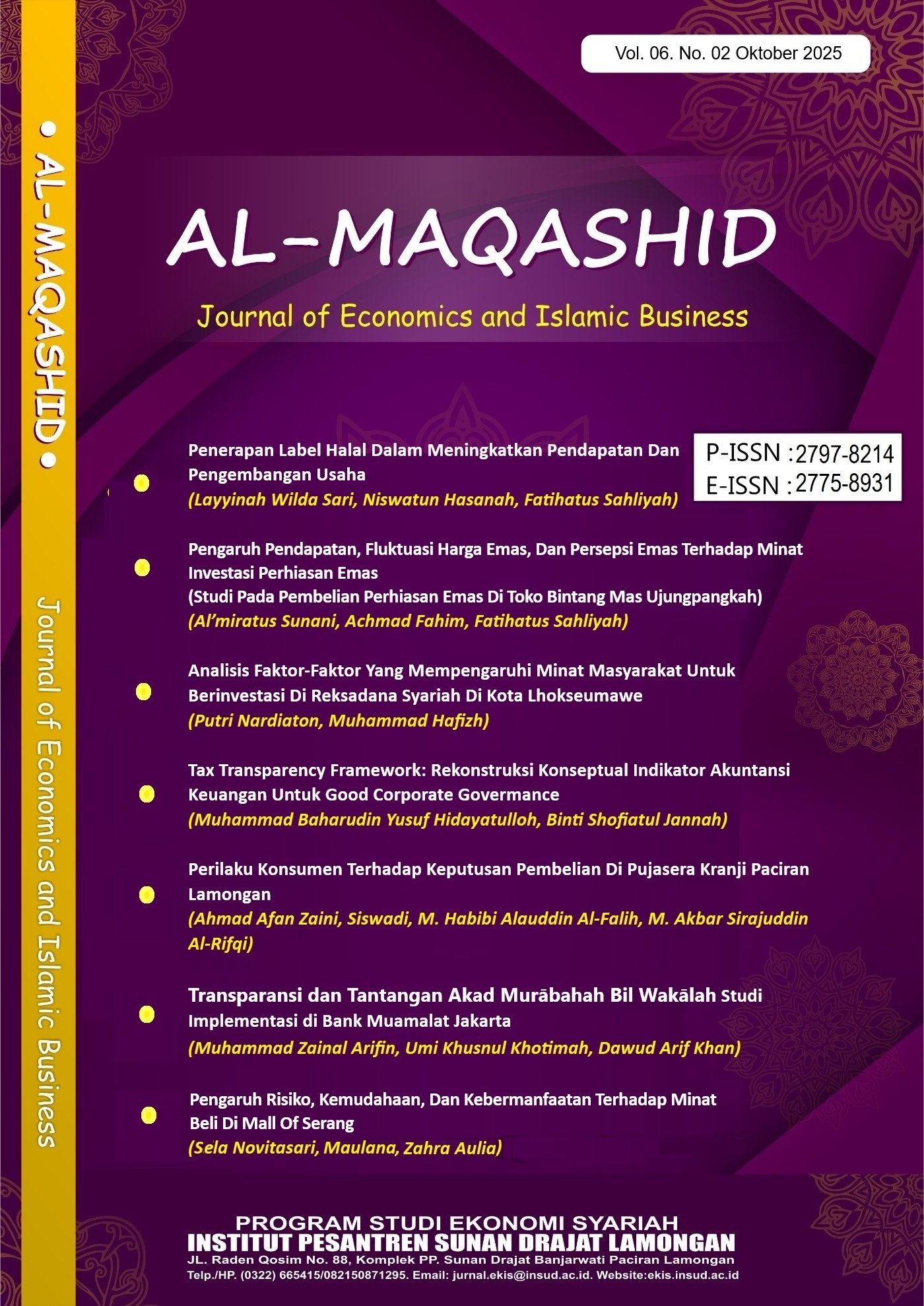
TRANSPARANSI DAN TANTANGAN AKAD MURĀBAHAH BIL WAKĀLAH
Studi Implementasi di Bank Muamalat Jakarta
DOI:
https://doi.org/10.55352/maqashid.v6i02.2218Keywords:
murābaḥah, wakālah, Bank Muamalat, Islamic financingAbstract
This study examines the implementation of the murābaḥah bi al-wakālah contract in car financing at Bank Muamalat Indonesia, the first Islamic bank that plays a significant role in the development of Islamic finance in the country. The research background is based on the dominance of the murābaḥah contract in the financing portfolio, as well as issues related to asset ownership and the customer’s role as wakīl, which remain subject to both normative and practical debates. The objective of this study is to provide a detailed analysis of the implementation stages of the murābaḥah bi al-wakālah contract at Bank Muamalat and to assess its compliance with DSN-MUI Fatwa No.04/DSN-MUI/IV/2000. A qualitative approach with a case study method was employed, using in-depth interviews, field observations, and document analysis. The findings reveal that Bank Muamalat’s operational procedures generally comply with Islamic legal principles, covering the stages of application, agency authorization, purchase, verification, murābaḥah contract execution, and installment monitoring. Nevertheless, two critical issues remain: insufficient documentation of asset ownership and the low level of customer understanding of their role as wakīl. These gaps may potentially shift the contract into a practice resembling conventional credit. The study concludes that strengthening ownership documentation and enhancing customer education are crucial to uphold shariah compliance. Academically, this research contributes to the literature on contemporary Islamic commercial jurisprudence, while practically it provides recommendations to improve the operational procedures of Islamic banking.
Downloads
References
Ani, Yunita. “Kajian Akad Pembiayaan Murābaḥah terhadap Penerapan Prinsip Syariah pada Bank Syariah di Indonesia.” Jurnal Ekonomi Syariah 5, no. 2 (2021): 115–130.
Ascarya. Akad dan Produk Bank Syariah. Jakarta: Rajawali Pers, 2013.
Creswell, John W. Research Design: Qualitative, Quantitative, and Mixed Methods Approaches. 4th ed. Thousand Oaks: Sage Publications, 2014.
Dewan Syariah Nasional Majelis Ulama Indonesia. Fatwa DSN-MUI No.04/DSN-MUI/IV/2000 tentang Murābaḥah. Jakarta: DSN-MUI, 2000.
Lexy J., Moleong. Metodologi Penelitian Kualitatif. Bandung: Remaja Rosda Karya, 2018.
Miles, Matthew B., A. Michael Huberman, and Johnny Saldaña. Qualitative Data Analysis: A Methods Sourcebook. 3rd ed. Thousand Oaks: Sage Publications, 2014.
Otoritas Jasa Keuangan. Laporan Kinerja Tahunan 2023. Jakarta: OJK, 2023.
Otoritas Jasa Keuangan. Statistik Perbankan Syariah 2023. Jakarta: OJK, 2023.
Sugiyono. Metode Penelitian Kualitatif: Untuk Penelitian yang Bersifat Eksploratif, Enterpretatif, Interaktif, dan Konstruktif. Bandung: Alfabeta, 2017.
Sulaiman, Sofyan. “Problematika Kepemilikan Objek Transaksi dalam Akad Murābaḥah bi al-Wakālah.” Al-Iqtishad: Jurnal Ilmu Ekonomi Syariah 13, no. 1 (2022): 45–60.
Zainal Arifin, M. Implementasi Akad Murābaḥah bi al-Wakālah pada Pembiayaan Mobil di Bank Muamalat Indonesia. Tesis, Jakarta, 2025.
Downloads
Published
Issue
Section
License
Copyright (c) 2025 Muhammad zainal arifin, Umi Khusnul Khotimah, Dawud Arif Khan

This work is licensed under a Creative Commons Attribution-ShareAlike 4.0 International License.