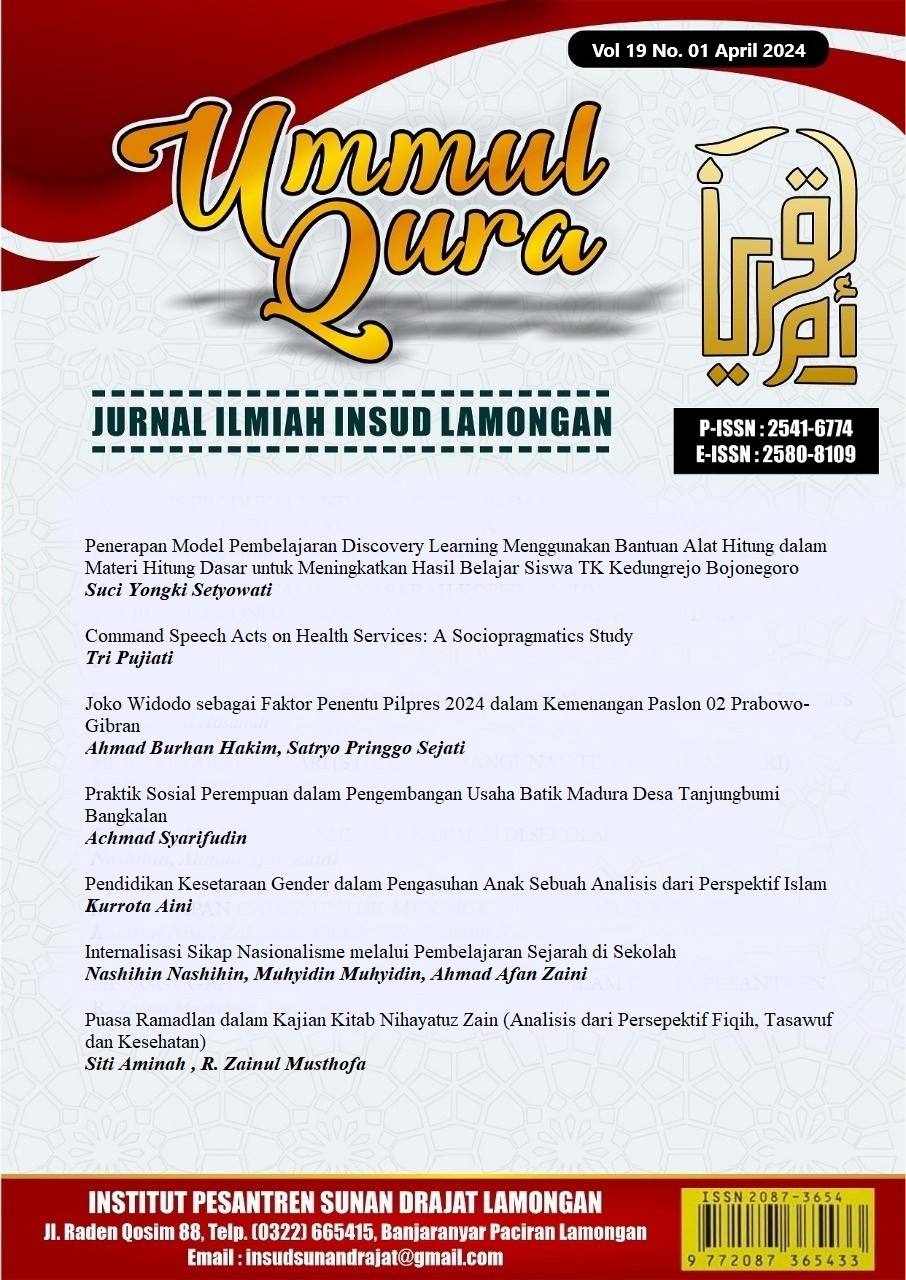
Pendidikan Kesetaraan Gender dalam Pengasuhan Anak Sebuah Analisis dari Perspektif Islam
DOI:
https://doi.org/10.55352/uq.v19i1.864Keywords:
Gender Equality, Child Gender Education, Raising Children in IslamAbstract
This study focuses on the importance of gender equality education for children from an Islamic perspective, emphasizing education towards the formation of understanding, attitudes, and behaviors that support gender equality and justice from an early age. This research uses a literature study method, aiming to explore how Islamic teachings in the Quran and Hadith provide a strong foundation for promoting gender equality, challenging stereotypes and gender discrimination, and supporting the development of each individual's potential without gender distinction. The findings indicate that gender equality education facilitates children in fully exploring and developing their potential, reducing gender-based discrimination and violence, and supporting children's mental health and well-being. This gender equality education also prepares children to participate equally in all aspects of life. From an Islamic perspective, gender equality education not only supports the intellectual, spiritual, and moral development of children but also emphasizes the importance of equality and justice between men and women. This research highlights the forms of gender education for children recommended in Islam, including the teaching of fundamental Islamic values such as mutual respect, empathy, and cooperation, and the integration of these values into daily life. It demonstrates that gender equality education in Islam can bridge tradition and modernity, enabling the younger generation to appreciate traditional wisdom while applying principles of equality and social justice. This study provides significant insights into how gender equality education can shape a more just and equal society.
Downloads
References
Arikunto, Suharsimi, and Cepi Safruddin Adbul Jabar. Evaluasi Program Pendidikan. Jakarta: Bumi Aksara, 2018.
Borba, Michele. UnSelfie: Why Empathetic Kids Succeed in Our All-About-Me World. New York: Touchstone, 2016.
Brown, Christia Spears, and Ellen A. Stone. “Gender Stereotypes and Discrimination.” 105–133, 2016.
Camelia, Lely, and Ine Nirmala. “Penerapan Pendidikan Seks Anak Usia Dini Menurut Perspektif Islam.” Yaa Bunayya: Jurnal Pendidikan Anak Usia Dini 1, no. 1 (2017).
Croft, Alyssa, Toni Schmader, Katharina Block, and Andrew Scott Baron. “The Second Shift Reflected in the Second Generation.” Psychological Science 25, no. 7 (July 2, 2014): 1418–1428.
Hamid, Hamdani, and Beni Ahmad Saebani. Pendidikan Karakter Perspektif Pendidikan Islam. Bandung: CV. Pustaka Setia, 2012.
Hassan, R. The Empowerment of Women in Islam. Kuala Lumpur: The Other Press, 2013.
Hermawati, Azwar Ananda, Rusdinal, and Eri Barlian. “Gender Education in the Family: From Islamic Perspective.” In Proceedings of the 2nd International Conference Innovation in Education (ICoIE 2020). Paris, France: Atlantis Press, 2020.
Hill, Catherine, and Holly Kearl. Crossing the Line: Sexual Harassment at School. Washington, DC: American Association of University Women, 2011.
Hyde, Janet S., Sara M. Lindberg, Marcia C. Linn, Amy B. Ellis, and Caroline C. Williams. “Gender Similarities Characterize Math Performance.” Science 321, no. 5888 (July 25, 2008): 494–495.
Intan, Fatma Rizki. “Pentingnya Pembelajaran Gender Di Lembaga Pendidikan Anak Usia Dini.” PERNIK Jurnal PAUD 5, no. 2 (April 2022): 15–24.
Kane, E. W. The Gender Trap: Parents and the Pitfalls of Raising Boys and Girls. New York University Press, 2012.
Killen, Melanie, and Adam Rutland. Children and Social Exclusion. Wiley, 2011.
Kiram, Muhammad Zawil. “Pendidikan Berbasis Gender Dalam Keluarga Masyarakat Aceh.” Community : Pengawas Dinamika Sosial 6, no. 2 (October 2020): 180–191.
Mardiah, Anisatul. “Fenomena Flexing: Pamer Di Media Sosial Dalam Persfektif Etika Islam.” International Conference on Tradition and Religious Studies 1, no. 1 (October 2022): 309–319.
Mazaya, Viky. “Kesetaraan Gender Dalam Perspektif Sejarah Islam.” Sawwa: Jurnal Studi Gender 9, no. 2 (May 15, 2014): 323.
Mukti, Ali. “Pendidikan Seks Untuk Anak Usia Dini Perspektif Islam.” Jurnal Harkat : Media Komunikasi Gender 12, no. 2 (March 27, 2018).
Nawangsari, Dyah. “Urgensi Pendidikan Seks Dalam Islam.” Tadris: Jurnal Pendidikan Islam 10, no. 1 (June 2015).
Risman, B. J., and G. Davis. “From Sex Roles to Gender Structure.” Current Sociology 61, no. 5–6 (2013): 733–755.
Seedat. “Islam, Feminism, and Islamic Feminism: Between Inadequacy and Inevitability.” Journal of Feminist Studies in Religion 29, no. 2 (2013): 25.
Sidiq, Y. H., and M. Erihadiana. “Gender Dalam Pandangan Islam.” Jurnal Ilmiah Ilmu Pendidikan 5, no. 3 (March 2022): 875–882.
Siri, Hasnani. “Gender Dalam Perspektif Islam.” Al-Maiyyah 7, no. 2 (December 2014).
Sugiyono. Metode Penelitian Kuantitatif Kualitatif Dan R&D. Bandung: Alfabeta, 2012.
Umar, N. Islam Jalan Tengah. Bandung: Mizan, 2011.
United Nations Women. The World Survey on the Role of Women in Development 2014: Gender Equality and Sustainable Development. New York: The Research and Data section of UN Women, 2014.
Wibisono, Yusuf. “Konsep Kesetaraan Gender Dalam Perspektif Islam.” Al Mabsut: Jurnal Studi Islam dan Sosial 6, no. 1 (April 2013): 97–112.
Zed, Mestika. Metode Penelitian Kepustakaan. Jakarta: Yayasan Pustaka Obor Indonesia, 2008.