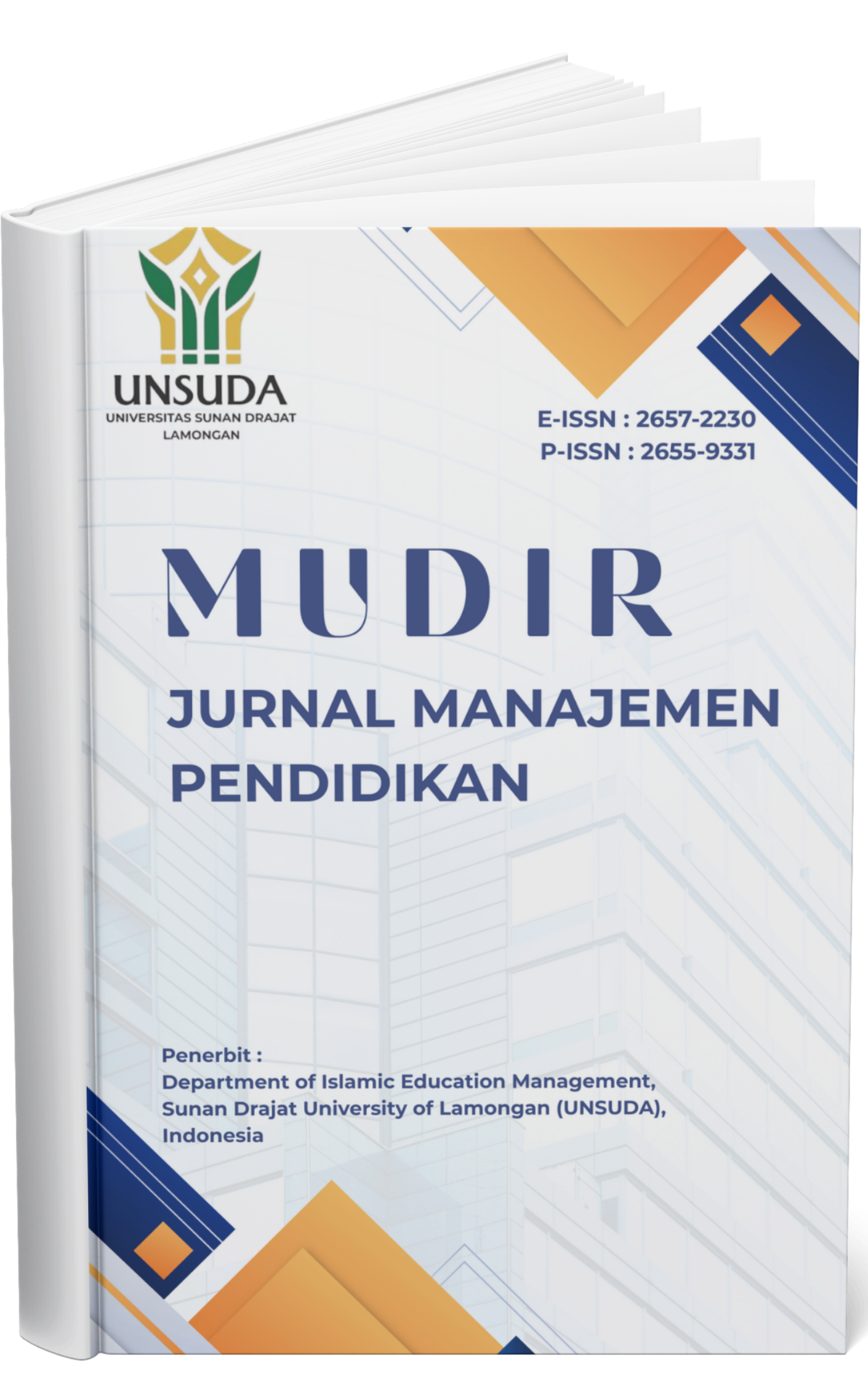
AI-Based Prophetic Curriculum in Islamic Religious Education: Integrating Humanization, Liberation, and Transcendence
DOI:
https://doi.org/10.55352/mudir.v8i2.2955Keywords:
Moral Ijtihad, Prophetic Curriculum, Artificial intelligence, Islamic Religious EducationAbstract
This research aims to formulate an ijtihad model of an Artificial Intelligence (AI)-based prophetic curriculum in Islamic Religious Education (PAI) from a curriculum management perspective. The study is motivated by the rapid transformation of education in the digital era, characterized by the widespread adoption of AI technologies that enhance learning efficiency and accessibility while simultaneously raising concerns related to ethics, dehumanization, and the erosion of educational values. This research employed a qualitative library research approach combined with normative-managerial conceptual analysis. Data were collected from peer-reviewed journal articles, scholarly books, and international reports published between 2013 and 2025, focusing on Islamic education, curriculum management, educational technology, and artificial intelligence. Sources were selected based on relevance, academic credibility, and contribution to discussions on prophetic education, AI integration, and curriculum development. The findings indicate that the development of an AI-based PAI curriculum requires a foundation of moral ijtihad as an ethical framework for responding to technological advancements. The proposed curriculum model integrates the prophetic values of humanization, liberation, and transcendence into the core functions of curriculum management, namely planning, organizing, implementation, and evaluation. The model offers several advantages over existing PAI curriculum frameworks by embedding prophetic values throughout the curriculum process, providing a structured mechanism for AI integration with ethical safeguards, and addressing contemporary challenges such as digital literacy, algorithmic bias, and technological dependency. These dimensions are often absent in conventional PAI curriculum models. Consequently, the proposed framework contributes to curriculum innovation and offers a conceptual basis for developing Islamic education policies and practices that balance technological advancement with character formation and spiritual development in the digital era.
Downloads
References
Arifin, F. (2025). Manajemen dan Kepemimpinan Lembaga Pendidikan Islam Kontemporer. CV Cendekia Press.
Bond, M., Bedenlier, S., Marín, V. I., & Händel, M. (2024). Emergency remote teaching in higher education: Mapping the first global online semester. Educational Technology Research and Development, 72(1), 1–25.
Cabero-Almenara, J., & Barroso-Osuna, J. (2025). The ethics of artificial intelligence in education: Towards responsible and inclusive use. Educación e Pesquisa, 51.
Faizuddin, F., & Wasehudin, W. (2024). Implementation of the Independent Curriculum in Technology-Based Islamic Education Learning Responds to Changes in Students’ Attitudes. Arfannur, 5(2), 67–77. https://doi.org/10.24260/arfannur.v5i2.2845
Fullan, M. (2013). Stratosphere: Integrating technology, pedagogy, and change knowledge. Pearson.
Hallinger, P. (2021). Instructional leadership and school improvement: A review of empirical evidence. Educational Administration Quarterly, 57(1), 5–35. https://doi.org/10.1177/0013161X19888720
Hamzah;, A. (2020). Metode penelitian kepustakaan (library research): Kajian filosofis, teoretis, aplikasi, proses, dan hasil penelitian. Literasi Nusantara Abadi. (Malang).
Hargreaves, A., & Fullan, M. (2020). Professional capital after the pandemic: Revisiting and revising classic understandings of teachers’ work. Educational Review, 72(5), 1–15.
Hasanah, U. (2025). Ethical AI implementation in educational settings. Ghancaran: Jurnal Pendidikan Islam, 6(2).
Holmes, W., Bialik, M., & Fadel, C. (2022). Artificial intelligence in education: Promise and implications for teaching and learning. Computers & Education, 179.
Irsyad, M., & Zakir, S. (2023). Transformasi AI dan Kurikulum: Tantangan Pendidikan Islam menghadapi Abad ke- 21. Al-Aulia: Jurnal Pendidikan Dan Ilmu-Ilmu Keislaman, 9(2), 156–170. https://doi.org/10.46963/aulia.v9i2.1395
Jannah, M., Aini, N., & Neni, N. (2025). Integrasi Nilai Religius dalam Desain Pembelajaran PAI Berbasis Teknologi Digital pada Era Society 5.0. AL-MUSTAQBAL: Jurnal Agama Islam, 2(4), 63–83. https://doi.org/10.59841/al-mustaqbal.v2i4.296
Kokotsaki, D., Menzies, V., & Wiggins, A. (2021). Project-based learning: A review of the literature. Journal of Educational Technology & Society, 24(3), 1–15.
Kuntowijoyo. (1991). Ilmu sosial profetik. Mizan.
Leithwood, K., & Seashore Louis, K. (2012). Linking Leadership to Student Learning. Educational Leadership Review, 1–40.
Luckin, R., Holmes, W., Griffiths, M., & Forcier, L. B. (2022). Intelligence unleashed: An argument for AI in education. Computers & Education, 180.
Mochizuki, Y. (2025). The ethics of AI or techno-solutionism? UNESCO’s policy framing. Journal of Education Policy.
Nasr, S. H. (1996). Religion and the order of nature. Oxford University Press.
Nguyen, A., Ngo, H. N., Hong, Y., Dang, B., & Nguyen, B. P. (2023). Ethical principles for artificial intelligence in education. Education and Information Technologies, 28, 4221–4241.
Rahman, F. (1982). Islam and modernity: Transformation of an intellectual tradition. University of Chicago Press.
Selwyn, N. (2021). Should robots replace teachers? AI and the future of education. Polity Press.
Sulaiman, A., & Saefuddin, D. (2023). Prophetic education and digital transformation in Islamic learning. Journal of Islamic Education Studies, 11(2), 145–162.
Tondeur, J., Scherer, R., Siddiq, F., & Baran, E. (2021). A comprehensive framework for teachers’ digital competence. Teaching and Teacher Education, 98.
UNESCO. (2023). Digital competence framework for educators. UNESCO Publishing.
UNESCO. (2025). AI and education: Protecting the rights of learners. UNESCO.
Wiese, L. J. (2025a). AI ethics education: A systematic literature review. Computers and Education: Artificial Intelligence, 6.
Wiese, L. J. (2025b). AI ethics education: A systematic literature review. Computers and Education: Artificial Intelligence, 6.
Williamson, B., & Eynon, R. (2023). Historical threads, missing links, and future directions in AI in education. Journal of Education Policy, 38(1), 1–20.
World Economic Forum. (2024). AI and human values in education. WEF.
Zawacki-Richter, O., Marín, V. I., Bond, M., & Gouverneur, F. (2023a). Systematic review of research on artificial intelligence applications in higher education. International Journal of Educational Technology in Higher Education, 20(1).
Zawacki-Richter, O., Marín, V. I., Bond, M., & Gouverneur, F. (2023b). Systematic review of research on artificial intelligence applications in higher education. International Journal of Educational Technology in Higher Education, 20(1).
Downloads
Published
Issue
Section
License
Copyright (c) 2026 Mudir: Jurnal Manajemen Pendidikan

This work is licensed under a Creative Commons Attribution-ShareAlike 4.0 International License.