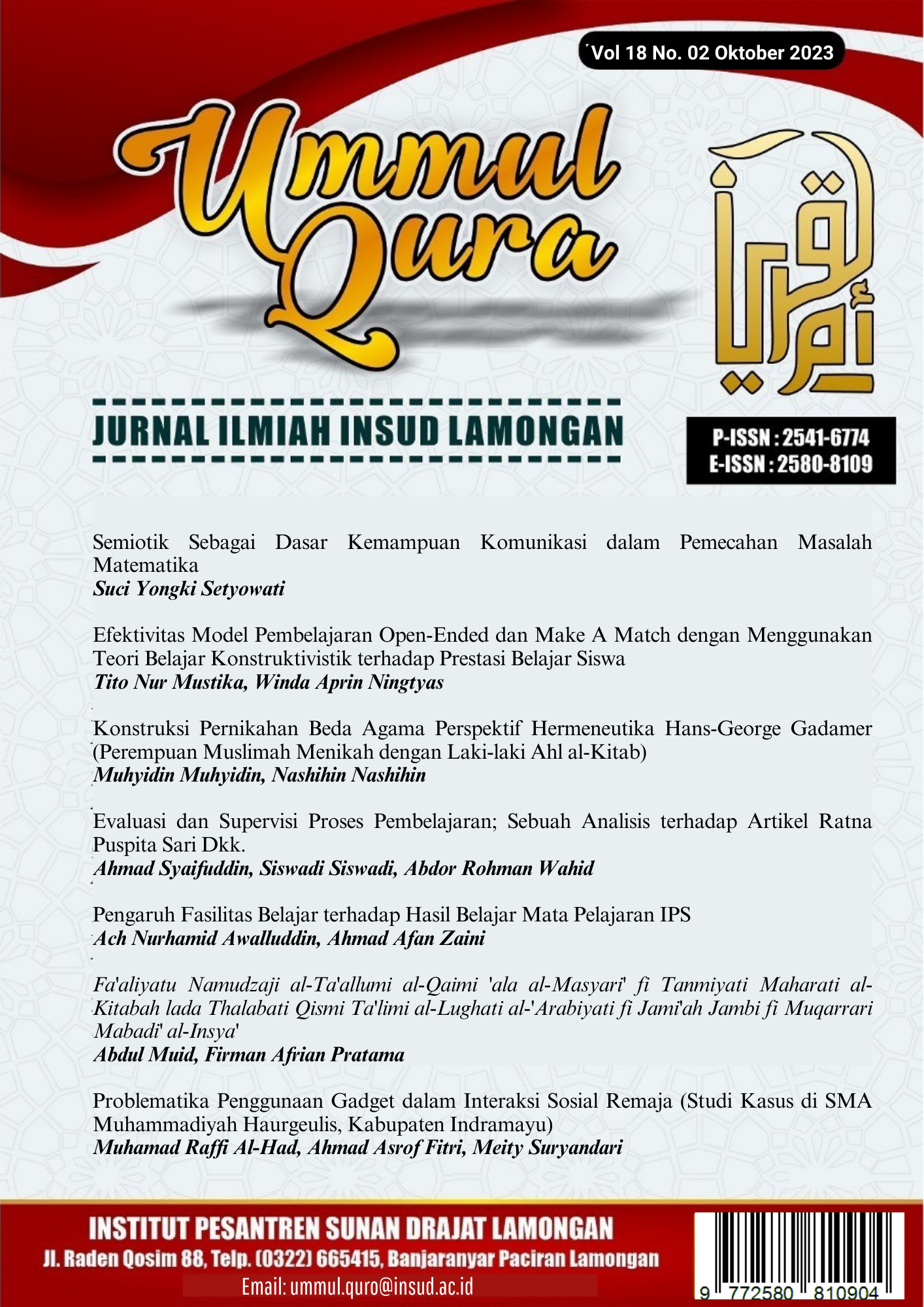
Efektivitas Model Pembelajaran Open-Ended dan Make A Match dengan Menggunakan Teori Belajar Konstruktivistik terhadap Prestasi Belajar Siswa
DOI:
https://doi.org/10.55352/uq.v18i2.639Keywords:
Open-Ended, Make A Match, Descriptive/Exposure, teachers and studentsAbstract
Learning activities at school are important activities for students, especially learning activities that are held in the classroom. Learning activities between teachers and students must be established in harmonious interactions and relationships, so that in learning activities in the classroom there is a conducive and active atmosphere. This study used three classes, namely Experiment I class (Open-Ended), Experiment II class (Make A Match) and Control class (Descriptive/Exposure). Before giving the treatment, firstly take the value data for the initial data to match the three classes. For initial data analysis, a normality test was calculated with the Liliefors test, homogeneity test with the Bartlett test, and the average comfort test using one-way Anava. After giving the treatment and evaluation tests, the final data analysis calculations were carried out to test the research hypothesis. For the final analysis, it was carried out as the initial analysis plus the t test. The research results for hypothesis 1, there is a difference in the average learning achievement between experimental class I, II and control. For hypothesis 2, the learning achievement of the experimental class I is better than the control class. For hypothesis 3, the learning achievement of experimental class II is better than the control class. For hypothesis 4, there is no difference in learning achievement between experimental class I and experimental class II. So, learning using the Open-Ended model and the Make A Match learning model on Logarithmic Mathematics material is better than the Descriptive/Exposure learning model
Downloads
References
Ambarjaya, Beni S. Psikologi Pendidikan dan Pengajaran (Teori dan Praktik). Yogyakarta: CAPS. 2012.
Arifin, Zainal. Evaluasi Pebelajaran. Bandung: PT. Remaja Rosdakarya. 2011.
Arikunto, Suharsimi. Dasar-dasar Evaluasi Pendidikan. Aneka Cipta: Jakarta. 2010.
Hamdani. Strategi Belajar Mengajar. Bandung: Pustaka Setia. 2011.
Mulyasa, E. Menjadi Guru Profesional. Bandung: PT Remaja Rosdakarya. 2009.
Rusman. Model-model Pembelajaran Mengembangkan Profesionalisme Guru. Jakarta: Rajawali Pers. 2014
Setiamihardja, Realin., Kusmiyati. Pendekatan Open Ended dalam PembelajaranMatematika di Sekolah
Dasar. JURNAL, Pendidikan Dasar No: 8, Oktober 2007
Shoimin, Aris. 68 Model Pembelajaran Inovatif dalam Kurikulum 2013.Yogyakarta:Ar-Ruz Media. 2014.
Siregar, Eveline.,Hartini Nara. Teori Belajar dan Pembelajaran. Bogor: Ghalia Indonesia. 2014.
Slameto. Belajar dan Faktor-Faktor yang Mempengaruhinya. Jakarta: Rineka Cipta. 2013.
Sudjana. Metoda Statistika. Bandung: Penerbit Tarsito. 2005.
Sugiyono. Statistika Untuk Penelitian. Bandung: Alfabeta. 2010.
Sugiyono. Metode Penelitian Kuantitatif, Kualitatif dan R&D. Bandung: Alfabeta. 2012.
Sugiyono. Metode Penelitian Pendidikan. Bandung: Alfabeta. 2014.