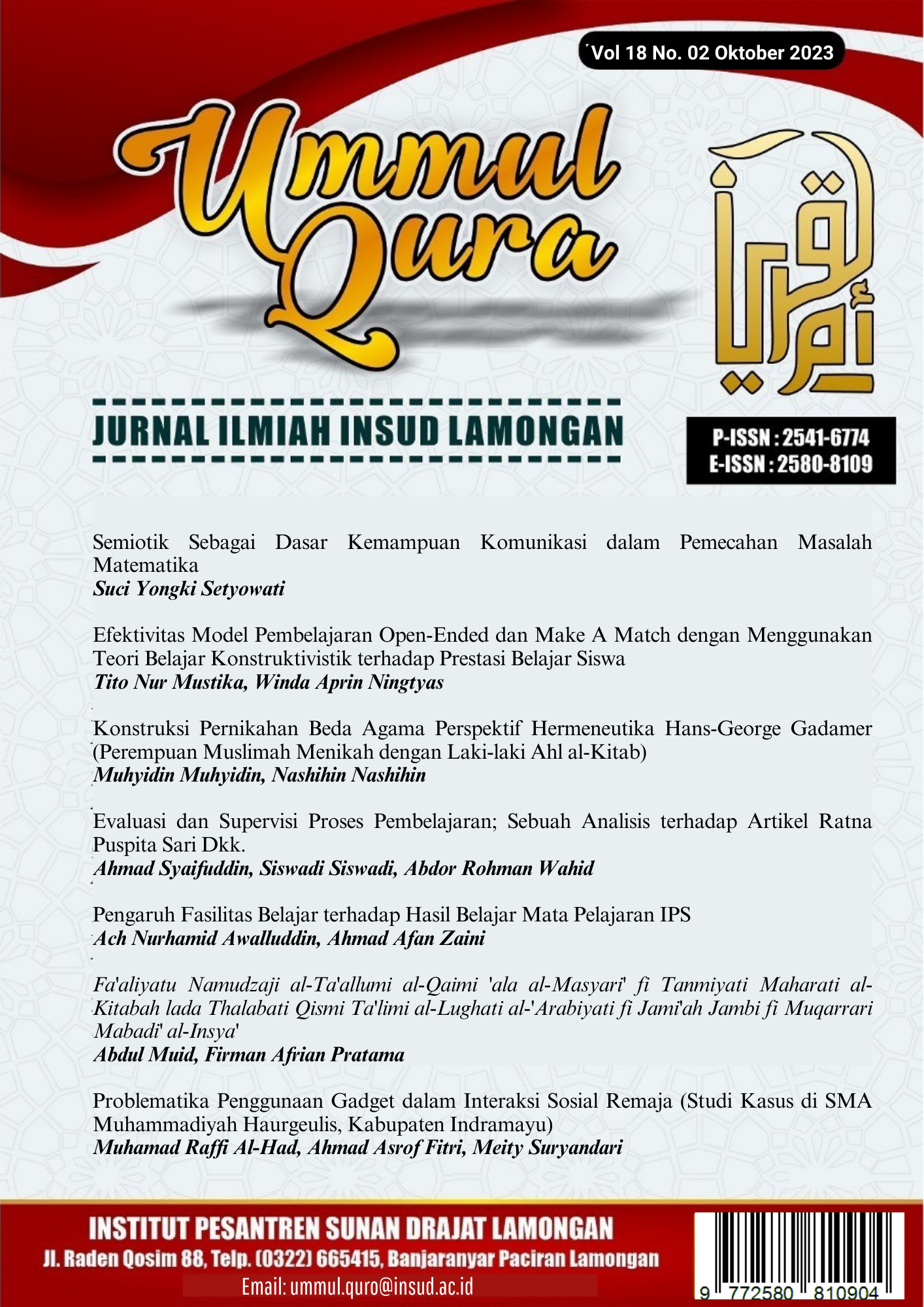
Problematika Penggunaan Gadget dalam Interaksi Sosial Remaja (Studi Kasus di SMA Muhammadiyah Haurgeulis, Kabupaten Indramayu)
DOI:
https://doi.org/10.55352/uq.v18i2.683Abstract
Gadgets are modern communication devices that have changed people's lives in social interaction, providing benefits in terms of work efficiency, communication with family, and entertainment. However, too much gadget use can cause an imbalance in daily activities and impair well-being. Social interaction is key in human life, and smartphones are one of the main media used in social interaction. This study highlights two sides of smartphone use: positive and negative. This study describes the impact of gadget use, especially smartphones, on adolescent social interaction, focusing on high school students and wants to explore the impact of gadget use by understanding the problematic use of gadgets among Haurgeulis high school students, identifying the forms of social interaction that occur among students, and analyzing the positive and negative impacts. The results of this study show that: (1) The problematic use of gadgets among students has positive benefits, including work efficiency and communication with family, while negative impacts include an imbalance between time spent using gadgets and physical activity, potentially causing health problems such as eye minus. (2) Students also engage in two forms of social interaction, namely associative interaction involving cooperation with parents and the formation of class groups, as well as dissociative interaction involving the spread of fake news and competition in showing off smartphones. (3) The use of gadgets by students has positive impacts, such as better time management and easy access to lesson information, but also has negative impacts in the form of competition between students and inconvenience.
Downloads
References
Avina, Nurma. “Dampak Penggunaan Smartpone Terhadap Interaksi Sosial Pemuda Desa Mulyosari Kecamatan Way Ratai Kabubaten Pesawaran.” Layanan Perpustakaan UNRIL Referensi. Universitas Islam Negeri Raden Intan Lampung, 2021. http://repository.radenintan.ac.id/id/eprint/13587.
Farida, Ai, Unik Hanifah Salsabila, Liska Liana Nur Hayati, Jihan Ramadhani, and Yulia Saputri. “Gadget Optimization and Its Implications on Children’s Patterns.” Jurnal Inovasi Penelitian 1, no. 8 (2021): 1701–1710.
Firdaus, Firdaus, Rifqi Muntaqo, and Eli Trisnowati. “Analysis of Student Readiness for Blended Learning Model Implementation in Industrial Era 4.0.” Indonesian Journal of Science and Education 4, no. 1 (2020): 48.
Hertmada, Sinta Kendek. “Dampak Penggunaan Handphone Terhadap Proses Interaksi Sosial Dikalangan Mahasiswa Akademi Kebidanan Sinar Kasih Tana Toraja.” Universitas Hasanudin, 2017.
Mokodompis, Jemmy R. “Pola Interaksi Sosial Masyarakat Dalam Menunjang Pelaksanaan Pemerintahan Desa1 (Studi Kasus Di Desa Pokol Kecamatan Tamako Kabupaten Kepulauan Sangihe).” Politico: Jurnal Ilmu Politik 2, no. 6 (2015).
Musfiqon, and Nurdyansyah. Pendekatan Pembelajaran Saintifik. Sidoarjo: Nizamia Learning Center, 2015.
Nugrahani, Farida. Metode Penelitian Kualitatif Dalam Penelitian Pendidikan Bahasa. Solo: Cakra Books, 2014.
Sidiq, Umar, and Moh. Miftahul Choiri. Metode Penelitian Kualitatif Di Bidang Pendidikan. Edited by Anwar Mujahidin. Ponorogo: CV. Nata Karya, 2019.
Supardi, Supardi. “Populasi Dan Sampel Penelitian.” Unisia 13, no. 17 (1993): 100–108.
Syahyudin, Dindin. “Pengaruh Gadget Terhadap Pola Interaksi Sosial Dan Komunikasi Siswa.” Gunahumas: Jurnal Kehumasan 2, no. 1 (2020): 272–282.