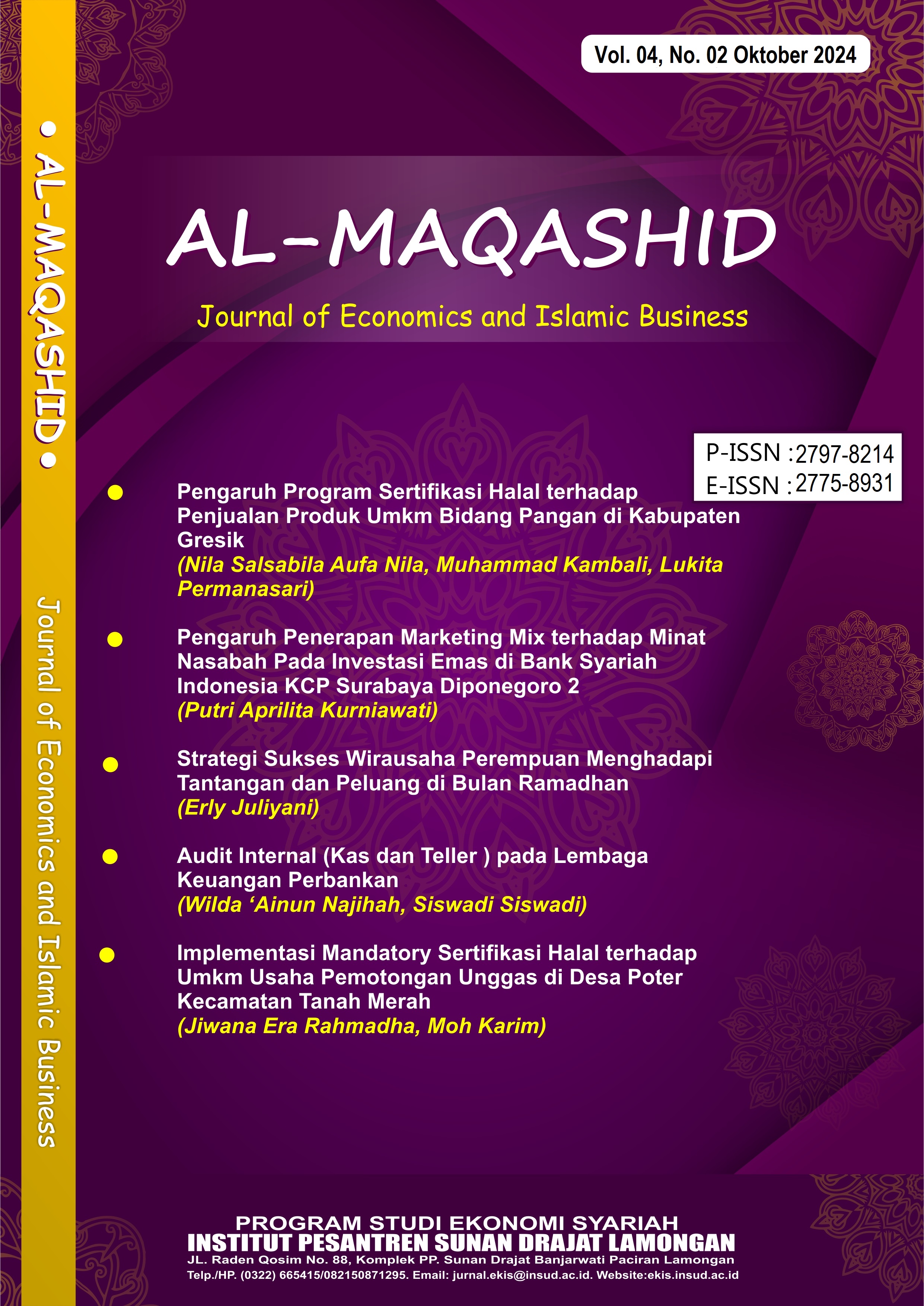
Implementasi Mandatory Sertifikasi Halal terhadap Umkm Usaha Pemotongan Unggas di Desa Poter Kecamatan Tanah Merah
DOI:
https://doi.org/10.55352/maqashid.v4i2.1185Keywords:
Halal certification program, Poultry Slaughtering BusinessAbstract
Halal certification has an important role in micro, small and medium enterprises, especially in poultry slaughtering businesses. This certification refers to the recognition that the product meets Islamic sharia standards, which is very important for Muslim consumers. A poultry slaughterhouse is a place where the process of slaughtering animals such as chickens, ducks, geese, and others that are processed for meat occurs. This poultry slaughterhouse is usually equipped with various facilities to ensure that the slaughtering is carried out hygienically and in accordance with food safety standards. In this case, halal certification is very important, because it can be used as a reference in ensuring that all meat production processes are in accordance with Islamic sharia principles. The purpose of this study was to determine how the implementation of halal certification and mandatory halal certification for Poultry Slaughtering businesses, this study is expected to make poultry slaughtering business actors aware of the importance of halal certification in micro, small and medium enterprises in the poultry slaughtering business. One of the poultry slaughterhouse s in Poter Village, Tanah Merah District, which is the main place for slaughtering poultry to be studied. The research methodology used is qualitative with a field research approach, involving interviews and direct observation at the research location.
Downloads
References
Apriani, Fitri. “PENERAPAN SISTEM JAMINAN HALAL PADA RUMAH POTONG HEWAN (RPH) RUMINANSIA KOTA SINGKAWANG.” Cross-Border 5, no. 2 (2022): 1717–23.
Eva Diyah, Nadiya, Anggun Riyanti, and Moh Karim. “IMPLEMENTASI SERTIFIKASI HALAL PADA KULINER UMKM KECAMATAN BURNEH KABUPATEN BANGKALAN.” SIBATIK JOURNAL: Jurnal Ilmiah Bidang Sosial, Ekonomi, Budaya, Teknologi, Dan Pendidikan 1, no. 12 (November 26, 2022): 2863–74. https://doi.org/10.54443/sibatik.v1i12.461.
Muawwanah, Siti Hoiriyatul, and Ahmad Makhtum. “Analisis Persepsi Sertifikasi Halal Pada Pelaku Usaha Kecil Mikro Di Kabupaten Sumenep.” BILAL 3, no. 2 (December 2022): 140–48. http://ojs.polmed.ac.id/index.php/Bilal/index.
Muhammad. “Tantangan Dan Peluang Penerapan Mandatory Sertifikasi Halal(Studi Implementasi Uu No. 33 Th. 2014 Dan Pp No. 31 Th. 2019).” Ilmu Ekonomi Dan Bisnis Islam - JIEBI 2 (2020).
Onibala, R Natalia, and Bernhard Tewal. “PENGARUH PENDIDIKAN, PELATIHAN DAN PENGEMBANGAN KARIR TERHADAP KINERJA PEGAWAI PADA KANTOR PELAYANAN KEKAYAAN NEGARA DAN LELANG MANADO.” JurnalEMBA, 2017.
Putri, Dina Soes, - Asmawati, and Adi Gunawan. “Counselling and Assistance in Submitting MUI Halal Certification for MSMEs Members of the North Lombok ’Aisyiyah Regional Leader.” KACANEGARA Jurnal Pengabdian Pada Masyarakat 6, no. 3 (August 1, 2023). https://doi.org/10.28989/kacanegara.v6i3.1598.
Rahim, Syamsuri, Tiara Halifah, Puspa Sari, Nur Wahyuni, Kata Kunci:, Makanan Halal, Peningkatan Pendapatan, Uji Regresi, and Linear Sederhana. “Halaman | 69 PENGARUH SERTIFIKAT HALAL TERHADAP PENINGKATAN PENDAPATAN PENJUALAN USAHA DI SEKTOR FOOD AND BEVERAGE KOTA MAKASSAR.” Bisnis&Kewirausahaan 12 (2023). https://e-jurnal.nobel.ac.id/index.php/jbk.
Setiyo utomo, Deny Slamet. Bentuk Perlindungan Hukum Pelaku Usaha Pesaing Terhadap Posisi Dominan Dalam Penerapan Rule of Reason. Edited by Deswin Nur. I. Komisi Pengawas Persaingan Usaha, 2021.
Wahyunti, Sri, Jalan Anggrek, No 16, Ranggo Na’, and Kota Bima. “PERAN STRATEGIS UMKM DALAM MENOPANG PEREKONOMIAN INDONESIA DI TENGAH PANDEMI COVID 19.” J-ESA, 2020.