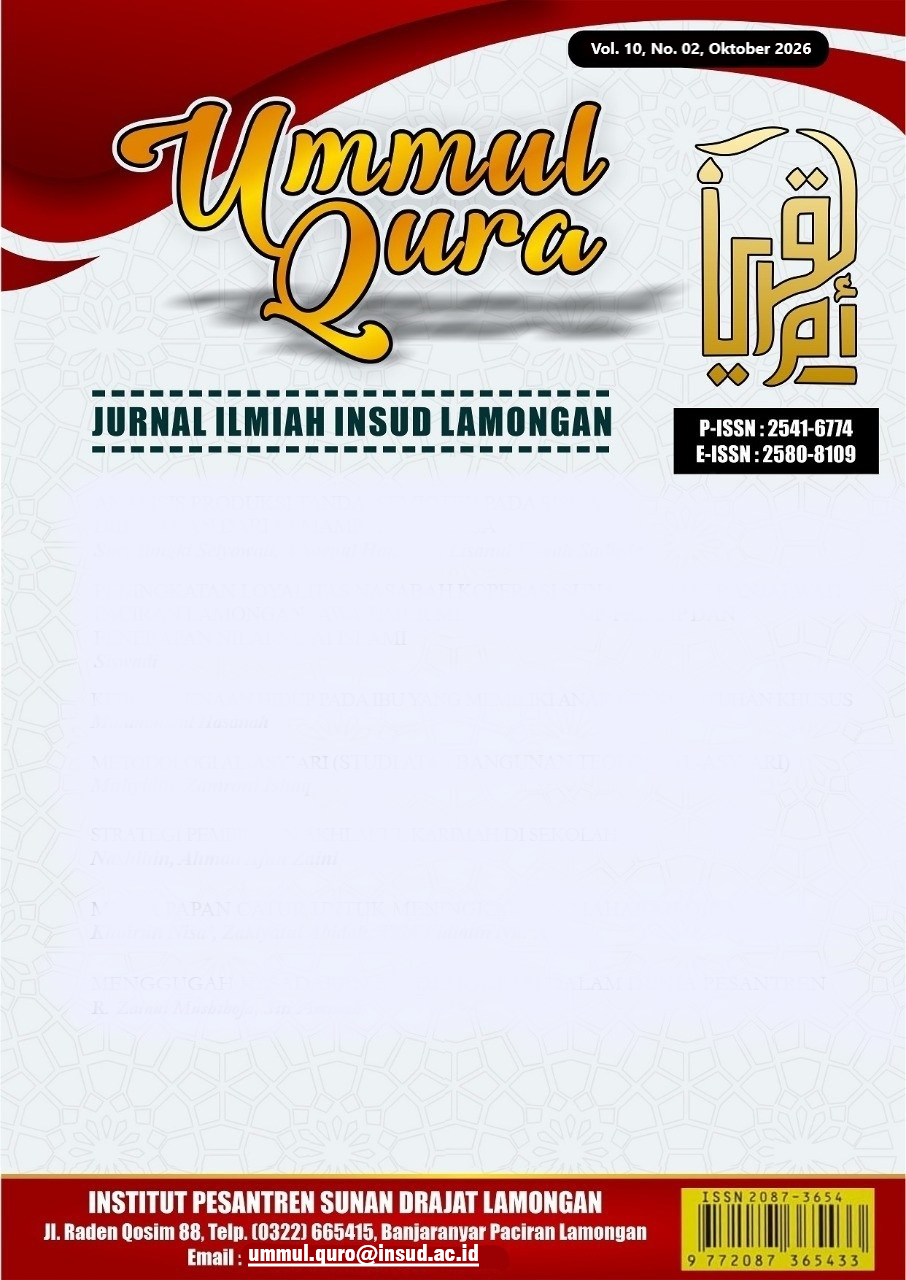
Analisis Uslub at-Tasybih dalam Al-Qur’an Perspektif Ilmu Balaghah
DOI:
https://doi.org/10.55352/uq.v10i2.3101Keywords:
Uslub at-tasybih, Arabic rhetoric, The Qur’anAbstract
Al-Qur’an is a miracle of Allah SWT, in which the beauty of the Arabic language is one of its aspects of inimitability. One form of this linguistic beauty appears in the use of the uslub at-tasybih (simile style) within the study of balaghah, particularly the science of bayan. Tasybih functions to clarify meaning, concretize abstract concepts, and strengthen the message conveyed in the Qur’an.This study aims to examine the uslub at-tasybih in the Qur’an through a rhetorical (balaghah) approach by identifying its elements, namely mushabbah, mushabbah bih, adat tasybih, and wajh asy-syibh, as well as classifying the forms of tasybih found within itThis research employs a qualitative method using a literature review approach. In the Qur’an, various forms of uslub at-tasybih are found, such as tasybih mursal, mu’akkad, mujmal, mufashshal, baligh, and tamtsil, each of which has a rhetorical function in clarifying meaning and strengthening the message. In addition, the use of tasybih also plays a role in presenting more concrete and aesthetic imagery of divine messages. Thus, the use of uslub at-tasybih in the Qur’an demonstrates both the beauty and the strength of its language in conveying meaning, as well providing a deeper understanding of the messages contained within it.
Downloads
References
A’la, M. R. (2021). Urgensi mengenal uslub khitabi untuk penulisan karya tulis dalam bahasa Arab. Al-Lisān Al-Arabī: Jurnal Program Studi Pendidikan Bahasa Arab. https://doi.org/10.61610/pba.v1i1.6
Al-Faruqi, A. (2022). Balaghah Al-Qur’an: Analisis Gaya Bahasa Tasybih, Majaz, dan Kinayah dalam Kajian Ilmu Ma’ani. Jakarta: Pustaka Ilmiah Nusantara.
Al-Khatib al-Qazwini. (1932). Syarh Talkhis al-Miftah. Qahirah.
Bagaskara, S. M., & Sausan, M. (2024). Elaborasi tasybih dalam Al-Qur’an pada surat Al-Baqarah. Jurnal Studi Sosial Keagamaan Syekh Nurjati.
Haniah. (2019). من بلاغة النظم القرآني في حديثه عن حقوق المرأة. Sipakalebbi. https://doi.org/10.24252/jsipakallebbi.v3i2.11898
Hakim, F. (2023). Uslub, uslubiyah dan kaitannya dengan ilmu balaghah. Al-Lisān Al-Arabī: Jurnal Program Studi Pendidikan Bahasa Arab. https://doi.org/10.61610/pba.v2i2.35
Hidayah, K., & Nuruddien, M. (2025). Gaya bahasa tasybih dalam Al-Qur’an: Studi balaghah terhadap ayat-ayat kiasan. Maliki Interdisciplinary Journal.
Ibnu Katsir. (2004). Tafsir Ibnu Katsir (Terj. M. Abdul Ghoffar E.M., Abu Ihsan Al-Atsari, & Abdurrahim Mu’thi). Bogor: Pustaka Imam Asy-Syafi’i.
Idris, M. (2007). Ilmu Balaghah antara Al-bayan dan Al-Badi’. Yogyakarta: Teras.
Nasution, U. K., & Lubis, A. C. (2025). Analisis tasybih dalam Al-Qur’an pada surah Ar-Rahman ayat 58 terhadap perspektif ilmu bayani. Al-Iftah: Jurnal Tafsir Al-Qur’an dan Hadist.
Ningsih, F., Hasibuan, A. N., & Nasution, I. K. (2024). Analisis kajian ilmu bayan tasybih adh-dhimni dalam QS. Al-A’raf ayat 40. Jurnal Pendidikan Tambusai.
Rachim, A. K., & Nuruddien, M. Mengungkapkan rahasia ayat-ayat tasybih dalam Al-Qur’an juz 27. Al-Mustafid: Jurnal of Qur’an and Hadist Studies.
Salim, A. M., Mardan, & Abubakar, A. (2012). Metodologi Penelitian Tafsir Maudu’i. Banten: Pustaka Arif.
Salleh, A. W. (2007). Ilmu Al-Bayan. Selangor: Pustaka Darul Bayan.
Suryaningsi, L., & Hendrawanto. (2017). Ilmu balaghah tasybih dalam manuskrip “Syarh Fi Bayan Al-Majaz Wa Al-Tasybih Wa Al-Kinayah”. Jurnal Al-Azhar Indonesia Seri Humaniora. https://doi.org/10.36722/sh.v4i1.245
Downloads
Published
Issue
Section
License
Copyright (c) 2026 M. Rayhan, Andi Miswar, Mohammad Harjum

This work is licensed under a Creative Commons Attribution-ShareAlike 4.0 International License.